
By Siam Accounting Solutions | Your Trusted Bookkeeping Partner
Table of Contents
Introduction: The Bookkeeping Landscape Is Changing
In today’s fast-paced digital economy, bookkeeping services have evolved far beyond the traditional ledger and spreadsheet. Business owners across industries now face a critical decision: should they invest in SaaS bookkeeping platforms or stick with regular bookkeeping services managed by dedicated human professionals? This comprehensive comparison explores both approaches in depth — covering cost, accuracy, scalability, automation, compliance, and real-world suitability — so you can make the most informed decision for your business.
Whether you are a startup founder, a growing SME, or an established enterprise, understanding the differences between cloud-based bookkeeping and traditional bookkeeping services is essential. The right bookkeeping solution can save thousands of dollars annually, ensure tax compliance, and free up valuable time. The wrong choice can cost you even more. Let us break it down.
What Is SaaS Bookkeeping?
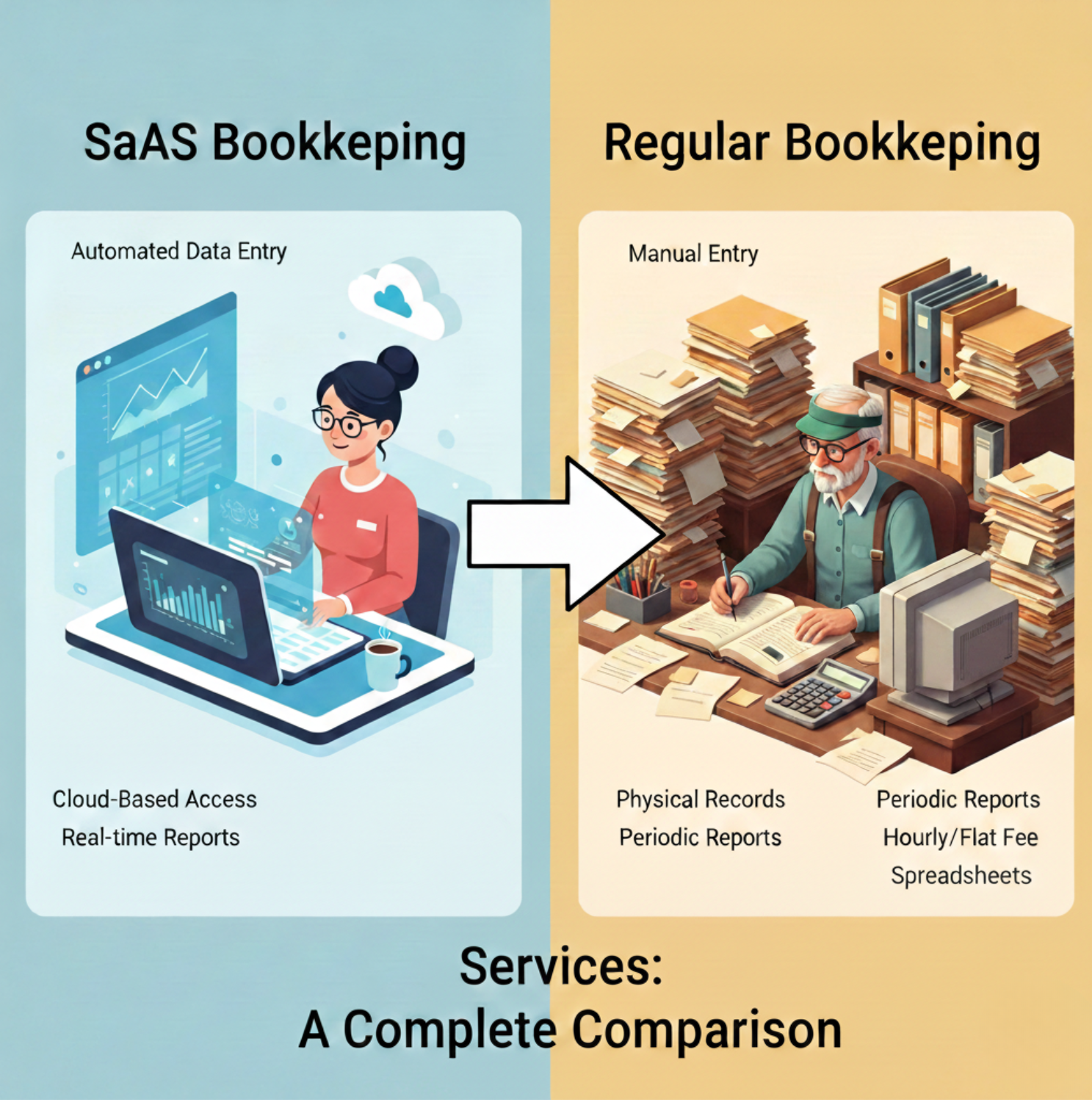
SaaS bookkeeping — or Software-as-a-Service bookkeeping — refers to cloud-hosted platforms that automate financial record-keeping, transaction categorization, invoicing, and reporting. These platforms include widely used tools like QuickBooks Online, Xero, FreshBooks, Wave, and Zoho Books. They operate on a subscription model, offering automated bookkeeping features accessible from any device with an internet connection.
SaaS bookkeeping platforms typically offer:
- Automated bank feed synchronization with real-time transaction import
- AI-powered expense categorization and reconciliation
- Cloud-based invoicing, billing, and payment processing
- Integrated payroll and tax preparation modules
- Dashboard-style financial reporting with visual analytics
- Multi-user access with role-based permissions
- API integrations with CRMs, e-commerce platforms, and POS systems
These platforms have revolutionized small business bookkeeping by making basic financial management accessible to non-accountants. However, they also come with limitations that make professional bookkeeping services essential for many businesses.
What Are Regular Bookkeeping Services?
Regular bookkeeping services — also called traditional bookkeeping services or professional bookkeeping services — are managed by qualified human bookkeepers or accounting firms. These professionals handle your financial data manually or through accounting software on your behalf, providing a personalized, hands-on approach to financial record management.
Regular bookkeeping services typically include:
- Manual or software-assisted data entry and transaction recording
- Bank reconciliation and accounts payable/receivable management
- Monthly, quarterly, and annual financial statement preparation
- Payroll processing and compliance management
- Tax preparation support and regulatory filings
- Financial advisory, budgeting, and cash flow guidance
- Industry-specific bookkeeping tailored to your business model
Firms like Siam Accounting Solutions offer full-service professional bookkeeping services that combine technology with human expertise — bridging the gap between pure SaaS automation and traditional manual bookkeeping.
SaaS Bookkeeping vs Regular Bookkeeping: Key Differences at a Glance
1. Cost Structure: SaaS bookkeeping platforms typically charge monthly subscription fees ranging from $10 to $150 per month depending on features and business size. Regular bookkeeping services charge either hourly rates ($25–$100/hour) or flat monthly retainer fees ($200–$2,000+ per month). For very early-stage startups, SaaS solutions appear cheaper upfront. However, when you factor in the hidden costs of DIY errors, tax penalties, and time spent managing the software, outsourced bookkeeping services often deliver a higher return on investment.
2. Accuracy and Error Prevention: One of the most significant advantages of regular bookkeeping services over SaaS platforms is accuracy. Automated systems rely on rule-based categorization that can mis-categorize transactions, misinterpret bank data, or miss business-specific nuances. Human bookkeepers apply contextual judgment, professional training, and industry knowledge to ensure every entry is accurate. For businesses with complex transactions, multiple revenue streams, or frequent unusual expenses, professional bookkeeping services dramatically reduce the risk of costly errors.
3. Automation and Efficiency: SaaS bookkeeping platforms excel at automation. Bank feeds sync daily, invoices are generated automatically, and financial reports are produced on demand with a single click. This saves enormous time on repetitive manual tasks. In contrast, traditional bookkeeping can be more time-intensive, particularly for data entry. However, modern professional bookkeeping services increasingly leverage the same SaaS tools — giving you the best of both worlds: software efficiency with human oversight.
4. Scalability: As your business grows, your bookkeeping needs become more complex. SaaS platforms scale relatively well for transaction volume but may struggle with multi-entity accounting, foreign currency management, or industry-specific compliance requirements. Regular bookkeeping services scale by assigning additional resources — bookkeepers, accountants, or CFO-level advisors — to meet growing demands, making them more adaptable for complex or rapidly scaling businesses.
5. Compliance and Tax Readiness: Tax compliance is a critical aspect of bookkeeping services. SaaS platforms offer tax category mapping and generate reports that can assist with tax filings, but they do not replace the expertise of a qualified bookkeeper or tax professional. Professional bookkeeping services ensure your books are audit-ready, VAT or GST compliant, and aligned with local regulatory requirements — especially important for businesses operating across multiple jurisdictions.
Advantages of SaaS Bookkeeping
Real-Time Financial Visibility
One of the standout advantages of SaaS bookkeeping platforms is real-time access to financial data. Dashboards display cash flow, profit and loss, outstanding invoices, and expense summaries at any moment. For business owners who want to make quick, data-driven decisions, this real-time bookkeeping capability is genuinely valuable.
Low Barrier to Entry
Starting with a SaaS bookkeeping solution requires no long-term commitment and minimal upfront cost. Most platforms offer free trials, and monthly subscriptions can be cancelled anytime. This flexibility makes SaaS attractive for solopreneurs, freelancers, and early-stage startups who need basic bookkeeping functionality without a large financial commitment.
Integration with Business Tools
Modern SaaS bookkeeping platforms integrate seamlessly with e-commerce platforms (Shopify, WooCommerce), payment processors (Stripe, PayPal), CRM systems, and project management tools. These integrations reduce manual data transfer and create a more connected financial ecosystem. For businesses with complex tech stacks, this bookkeeping integration capability is a significant advantage.
Anytime, Anywhere Access
Cloud-based bookkeeping software is accessible from any device, anywhere in the world. Remote teams, traveling executives, and multi-location businesses benefit greatly from this flexibility. Whether you are reviewing financials from a hotel room in Bangkok or checking cash flow from your mobile device, cloud bookkeeping ensures your financial data is always at your fingertips.
Disadvantages of SaaS Bookkeeping
Steep Learning Curve for Non-Accountants
Despite marketing claims of simplicity, SaaS bookkeeping platforms often require significant time to set up and learn properly. Chart of accounts configuration, tax category mapping, and understanding financial reports can overwhelm business owners without an accounting background. Mistakes made during initial setup — miscategorized accounts, incorrect opening balances — can compound into major problems by year-end.
Limited Professional Judgment
Software cannot replace human expertise. When a transaction falls outside normal patterns — an unusual asset purchase, a multi-currency payment, a complex contractor arrangement — SaaS bookkeeping tools often fail to categorize it correctly. Professional bookkeepers apply contextual knowledge, regulatory understanding, and business acumen that no algorithm can fully replicate.
Data Security Concerns
Entrusting sensitive financial data to cloud bookkeeping platforms introduces cybersecurity risks. While major SaaS providers invest heavily in security, data breaches, unauthorized access, and server downtime remain real concerns. Businesses operating in heavily regulated industries — healthcare, legal, finance — must carefully evaluate SaaS providers’ compliance certifications before adopting cloud-based bookkeeping services.
Hidden Costs and Subscription Creep
SaaS bookkeeping pricing can be deceptive. Entry-level plans often lack essential features — payroll, inventory tracking, multi-currency support — which are locked behind higher-tier subscriptions. Add-ons accumulate quickly, and by the time a business has unlocked all the features it actually needs, the monthly cost rivals or exceeds that of professional bookkeeping services. Always calculate the true total cost before committing to a SaaS bookkeeping platform.
Advantages of Regular Bookkeeping Services
Expert Human Oversight
The defining advantage of regular bookkeeping services is professional human expertise. A qualified bookkeeper brings accounting knowledge, industry experience, and regulatory awareness that software cannot match. They proactively identify errors, flag suspicious transactions, and advise on financial best practices — acting as a financial partner rather than just a data processor.
Industry-Specific Bookkeeping Expertise
Different industries have unique bookkeeping requirements. Construction companies need job costing. Retail businesses need inventory accounting. Healthcare providers need HIPAA-compliant record-keeping. Professional services firms need time-tracking integration. Regular bookkeeping services from specialist firms — like those offered across industries at Siam Accounting Solutions — are customized to your specific sector, ensuring compliance and accuracy.
Comprehensive Financial Reporting
Beyond recording transactions, professional bookkeeping services provide meaningful financial analysis. Experienced bookkeepers prepare detailed profit and loss statements, balance sheets, cash flow forecasts, and management accounts that give business owners a clear, accurate picture of financial health. This goes far beyond what automated dashboards typically provide.
Tax Compliance and Audit Readiness
Keeping accurate, compliant financial records is essential for tax filings and potential audits. Regular bookkeeping services ensure your books are organized, reconciled, and ready for your accountant or tax authority at any time. Professional bookkeepers stay current with changing tax laws, depreciation rules, and reporting requirements — protecting your business from penalties and liabilities.
Personalized Service and Relationship
Working with a dedicated bookkeeper or bookkeeping services firm creates a genuine professional relationship. Your bookkeeper learns your business, understands your goals, and provides advice tailored to your situation. This relationship-based service is something SaaS platforms can never offer. For business owners who value personal attention and expert guidance, professional bookkeeping services deliver unmatchable value.
Disadvantages of Regular Bookkeeping Services
Higher Cost for Simple Requirements
For businesses with minimal transaction volumes and straightforward finances, regular bookkeeping services can seem expensive relative to SaaS alternatives. If your bookkeeping needs are genuinely simple — a handful of monthly transactions, single revenue stream, no employees — a basic SaaS solution might serve you adequately at lower cost.
Dependent on Individual Availability
When working with a solo bookkeeper, business continuity depends on that individual’s availability. Illness, vacation, or departure can leave businesses without critical bookkeeping support at critical moments. Engaging a bookkeeping firm rather than an individual mitigates this risk by providing team-based coverage.
Who Should Choose SaaS Bookkeeping?
SaaS bookkeeping platforms are best suited for:
- Freelancers and solopreneurs with simple, low-volume finances
- Very early-stage startups on tight budgets exploring basic bookkeeping
- Businesses with tech-savvy founders comfortable managing financial software
- Companies supplementing existing bookkeeping services with specific automation tools
- Businesses needing specific integrations like e-commerce or POS connectivity
Even for these users, we recommend pairing SaaS tools with periodic professional bookkeeping reviews — at minimum quarterly — to catch errors and ensure compliance. For expert guidance on choosing the right approach for your business, contact Siam Accounting Solutions today.
Who Should Choose Regular Bookkeeping Services?
Regular bookkeeping services are the better choice for:
- SMEs and growing businesses with increasing financial complexity
- Companies in regulated industries requiring specialized compliance knowledge
- Businesses processing high transaction volumes requiring accuracy and speed
- Multi-entity businesses or those with foreign currency transactions
- Companies seeking strategic financial guidance beyond basic record-keeping
- Business owners who want to focus entirely on their core business, not finances
- Any business that has experienced SaaS-related errors, compliance issues, or financial confusion
The Hybrid Approach: Best of Both Worlds
The smartest bookkeeping solution for most growing businesses combines both approaches. Using SaaS platforms for automation — bank feeds, invoicing, expense capture — while engaging professional bookkeeping services for oversight, reconciliation, compliance, and financial advice delivers maximum value.
At Siam Accounting Solutions, we leverage industry-leading accounting software while providing the human expertise that ensures your books are always accurate, compliant, and meaningful. Our team handles the complexity so you can focus on growth — delivering the benefits of cloud bookkeeping combined with dedicated professional bookkeeping services.
SaaS Bookkeeping vs Regular Bookkeeping: Side-by-Side Comparison
Cost: SaaS — $10–$150/month subscription; Regular — $200–$2,000+/month retainer. Winner depends on complexity.
Accuracy: SaaS — Algorithm-dependent, prone to miscategorization; Regular — Human-reviewed, contextually accurate. Regular bookkeeping wins.
Automation: SaaS — Strong automation of repetitive tasks; Regular — Variable, increasingly tech-enabled. SaaS edges ahead for pure automation.
Compliance: SaaS — Basic tax categories, no regulatory advisory; Regular — Full compliance management. Regular bookkeeping wins decisively.
Scalability: SaaS — Good for volume, limited for complexity; Regular — Fully scalable with dedicated resources. Regular bookkeeping wins for complexity.
Personalization: SaaS — Generic, template-driven; Regular — Tailored to your business and industry. Regular bookkeeping wins.
Real-Time Access: SaaS — Excellent, 24/7 cloud access; Regular — Varies by firm, many now offer client portals. SaaS edges ahead.
Error Detection: SaaS — Limited to programmed rules; Regular — Proactive human identification. Regular bookkeeping wins.
Common Bookkeeping Mistakes Businesses Make
Regardless of whether you choose SaaS bookkeeping or regular bookkeeping services, certain mistakes can derail your financial management. The most common include:
- Mixing personal and business finances — a critical bookkeeping error that creates tax and liability complications
- Failing to reconcile bank accounts monthly — leading to undetected errors and fraud
- Neglecting accounts receivable — allowing unpaid invoices to damage cash flow
- Improper expense categorization — resulting in missed tax deductions or overclaimed deductions
- Not maintaining digital copies of receipts and invoices — creating audit vulnerability
- Attempting DIY bookkeeping without accounting knowledge — the most expensive mistake of all
Partnering with professional bookkeeping services eliminates virtually all of these risks. Learn more about how Siam Accounting Solutions helps businesses avoid these pitfalls.
How to Choose the Right Bookkeeping Service for Your Business
When evaluating bookkeeping options, consider these key factors:
- Transaction volume: High volume businesses benefit most from professional bookkeeping services
- Business complexity: Multiple entities, currencies, or revenue streams favor regular bookkeeping services
- Growth stage: Scaling businesses need adaptable bookkeeping that grows with them
- Industry: Regulated or specialized industries require expert bookkeeping knowledge
- Budget: Calculate true total cost including time investment, errors, and penalties
- Tax complexity: Complex tax situations always require professional bookkeeping support
For a personalized assessment of your bookkeeping needs, reach out to our team at Siam Accounting Solutions. We offer bookkeeping solutions tailored to businesses across industries and growth stages.
The Future of Bookkeeping: AI, Automation, and Human Intelligence
The bookkeeping industry is rapidly evolving. Artificial intelligence, machine learning, and automation are transforming how financial data is processed and analyzed. SaaS platforms are becoming increasingly sophisticated, with AI-driven categorization improving accuracy year over year. Yet even as technology advances, human expertise remains irreplaceable.
The future belongs to professional bookkeeping services that intelligently integrate technology — using AI for efficiency while applying human judgment for accuracy, compliance, and strategic insight. At Siam Accounting Solutions, we continuously invest in the latest bookkeeping technology while maintaining the human expertise that ensures your finances are truly in safe hands.
Conclusion: Making the Right Bookkeeping Decision
The SaaS bookkeeping vs regular bookkeeping debate does not have a one-size-fits-all answer. SaaS platforms offer convenience and automation for simple financial needs. Regular bookkeeping services deliver accuracy, compliance, expertise, and personalized support that is essential for growing and complex businesses.
For most businesses beyond the very earliest stage, professional bookkeeping services — ideally integrated with modern cloud-based tools — represent the smarter long-term investment. The cost of poor bookkeeping far exceeds the cost of getting it right from the start.
Ready to upgrade your bookkeeping services and take the guesswork out of your finances? Explore our full range of bookkeeping and accounting services, view our industry expertise, or contact us today for a free consultation. Our expert team at Siam Accounting Solutions is ready to help your business thrive.
Connect With Us
LinkedIn | Facebook | X (Twitter)
© Siam Accounting Solutions. All Rights Reserved.
